

For someone building one site for themselves, the "best" website builder is a personal-taste question. For an agency building sites for clients, it's a business question — about margins, hand-off, team workflow, and how much support load each platform dumps on you after launch. On those terms, Duda, Wix, and Webflow pull in genuinely different directions. Here's how they compare for professional, client-facing work. Duda links below use our affiliate tracking and open Duda.
The agency lens
Forget which builder a solo user "likes." An agency cares about four things a consumer never thinks about: can I present this under my own brand, can my team work in it together, can I hand a client a controlled editor instead of a support headache, and can I run many sites without rebuilding each one. That lens reorders everything.
| Duda | Wix | Webflow | |
|---|---|---|---|
| Built for | Agencies & teams at scale | Broad market, incl. solo users | Designers wanting pixel control |
| White-label / client hand-off | Core strength | Limited (Studio improves it) | Partial |
| Team collaboration & permissions | Deep | Growing | Present, design-led |
| Learning curve | Moderate | Gentle | Steep |
| Design ceiling | High within its system | Medium | Highest, near-code control |
Where Duda wins
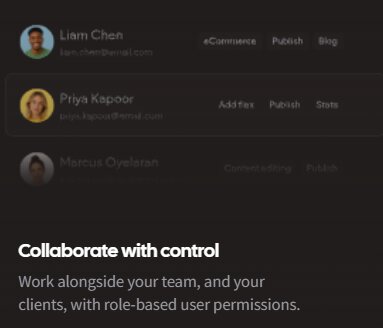
Client management and scale. Duda was built from the agency side: white-labelling, granular client-edit permissions, team roles, and tools for managing a portfolio of sites from shared templates. The payoff lands after launch — the part of client work that actually erodes agency margins. Handing a client a locked-down, branded editor where they can change the text but not break the layout turns ongoing maintenance from a drain into a clean deliverable. For an agency whose model is volume and retainer, that is the whole game, and it's where Duda is strongest.
Where Wix wins
Breadth and gentle onboarding. Wix is the most approachable of the three, with the largest app ecosystem and the widest range of built-in features out of the box — booking, e-commerce, marketing tools. Its dedicated agency product has narrowed the professional gap, and for a small studio serving clients who want to self-serve simple edits, Wix's familiarity is an asset. The trade-off is less depth on true white-label hand-off and multi-site management than Duda offers, so it fits lower-volume or less structured agency work better than a high-throughput shop.
Worth noting: Wix has pushed hard into the professional space with Wix Studio, its agency-focused product, which narrows the white-label and team-workflow gap considerably. If your objection to Wix was that it is not built for agencies, that is less true than it used to be. The honest read is that Wix Studio makes Wix a credible agency option for studios that also want the huge app marketplace, while Duda still leads on the depth and maturity of its client-management and multi-site tooling. For a studio weighing the two, it comes down to whether you prioritise ecosystem breadth or hand-off and portfolio depth.
Where Webflow wins
Design freedom. Webflow gives designers near-code control over layout, interactions, and animation without writing the code by hand, and it produces clean, performant output. For an agency whose selling point is bespoke, visually ambitious sites, nothing here matches its ceiling. The cost is the steepest learning curve of the three and a client hand-off that's less turnkey — Webflow rewards skilled builders and is overkill for a client who just needs a tidy, maintainable brochure site.
Webflow's other consideration is the ongoing cost and the client relationship it creates. Its hosting and CMS tiers are priced per site and add up across a portfolio, and because editing a Webflow site well takes real skill, clients rarely self-serve, which keeps them dependent on you. For some agencies that dependency is a feature that underpins a recurring retainer; for others it is exactly the support load they were trying to escape. Decide which model you want before you commit, because it shapes your margins more than the build experience ever will.
So which should your agency pick?
Match the tool to your business model, not to a feature checklist.
If your revenue comes from volume and retainers — building and maintaining many client sites efficiently — Duda is the strongest fit, because its white-label hand-off and multi-site tools attack the exact cost that eats agency profit. If you're a smaller studio serving clients who want an approachable platform with everything built in, Wix lowers the barrier and covers a lot of ground. If you sell bespoke design and have the skill to exploit it, Webflow gives you a ceiling the others can't reach.
The common error is choosing the platform that's nicest to build in and ignoring what happens after launch. For most client-facing agencies, the after-launch experience — hand-off, maintenance, and support load — is where the money is won or lost, and that's the column where Duda is purpose-built to win.

Don't forget migration and lock-in
One factor agencies underweight when choosing between the three: what happens if you want to leave. All three are closed platforms — you're building inside their system, not on portable open-source code, so moving a site elsewhere later means a rebuild, not an export. That's a normal trade for the convenience, but it raises the stakes on the initial choice. The practical hedge is to pick based on your dominant client type rather than an edge case, standardise your team on one platform so you build deep expertise instead of shallow familiarity with three, and treat the client hand-off model as the deciding factor — because the platform you can hand over cleanly is the one you'll happily keep renewing. For most volume agencies that calculus points back to Duda; for design-led shops it points to Webflow; for generalist studios, Wix.
FAQ
Which is best for white-labelling to clients? Duda, clearly — controlled client editing and branded hand-off are its core strengths, and the main reason agencies choose it over Wix or Webflow.
Is Webflow better than Duda? For bespoke design ceiling, yes. For running many client sites efficiently with clean hand-off, Duda is the more practical agency tool. They optimise for different jobs.
Is Wix good enough for an agency? For smaller or simpler client work, yes, and its onboarding is the gentlest. For high-volume, structured multi-site management, Duda's tooling goes deeper.
Which has the easiest learning curve? Wix, then Duda, then Webflow — Webflow trades ease for the most design control.
Deciding your agency stack? See how Duda handles white-label client hand-off before you lock in a platform.
Disclosure: This post contains affiliate links. We may earn a commission from purchases made through these links at no extra cost to you. Features and pricing were accurate at the time of writing.
Affiliate link — we may earn a commission at no extra cost to you.
Want gear like this on your content calendar?
Join AffluencerHub, get AI-matched to brand programs that fit your audience, and track every click to commission in one place.
Apply as a Creator