
Most people buy the wrong air purifier. Not because they picked a bad brand, but because they trusted the box that said "covers up to 1,500 sq ft" and put a small unit in a large room.
The result is a purifier that runs constantly, sounds like a hair dryer and never quite catches up to the air. This guide fixes that. By the end you'll know which specs matter, how to size a unit to your room, and which Levoit model matches which use case.
Three numbers, one formula
The three numbers that actually matter
Forget everything else on the box. These three decide whether a purifier will work.
1. CADR
Clean Air Delivery Rate in cubic feet per minute — how much filtered air the unit produces. Three sub-figures for dust, smoke and pollen, usually similar. Higher is better. A Core 300 does 141 CFM smoke; a Core 600S hits 410.
2. Coverage at 4 ACH
Boxes quote coverage at 1 air change per hour because it makes the number bigger. Ignore it. A Core 400S covers 403 sq ft at 4 ACH — or 1,733 sq ft at 1 ACH. The 403 is the real number.
3. HEPA grade
True HEPA captures at least 99.97% of particles at 0.3 microns. H13 is the European rating — same efficiency, tighter tolerances at the smallest sizes. Every current Levoit Core and Vital uses H13.
What to reject outright
Anything labelled "HEPA-type", "HEPA-like" or "99% HEPA". Those are marketing terms with no standard behind them.
How to calculate the right size
Skip the manufacturer coverage claims and do the math yourself. Multiply your room's square footage by 0.75. That's the minimum CADR for four air changes per hour, assuming standard 8-foot ceilings.
- 150 sq ft bedroom — needs 112 CFM. Core 300 (141 CFM) fits.
- 300 sq ft living room — needs 225 CFM. Core 400S (260 CFM) fits.
- 500 sq ft open kitchen — needs 375 CFM. Core 600S (410 CFM) fits.
- 700 sq ft great room — needs 525 CFM. Two 400S units, or a single 600S run continuously.
If your ceilings are higher than 8 feet, multiply square footage by ceiling height and divide by 8 before applying the 0.75 factor. A 500 sq ft room with 10-foot ceilings behaves like a 625 sq ft room with 8-foot ceilings.
Undersize by 20% and it still works, just slower. Undersize by 50% and you will never catch up to a real particle event.
Understanding HEPA filtration
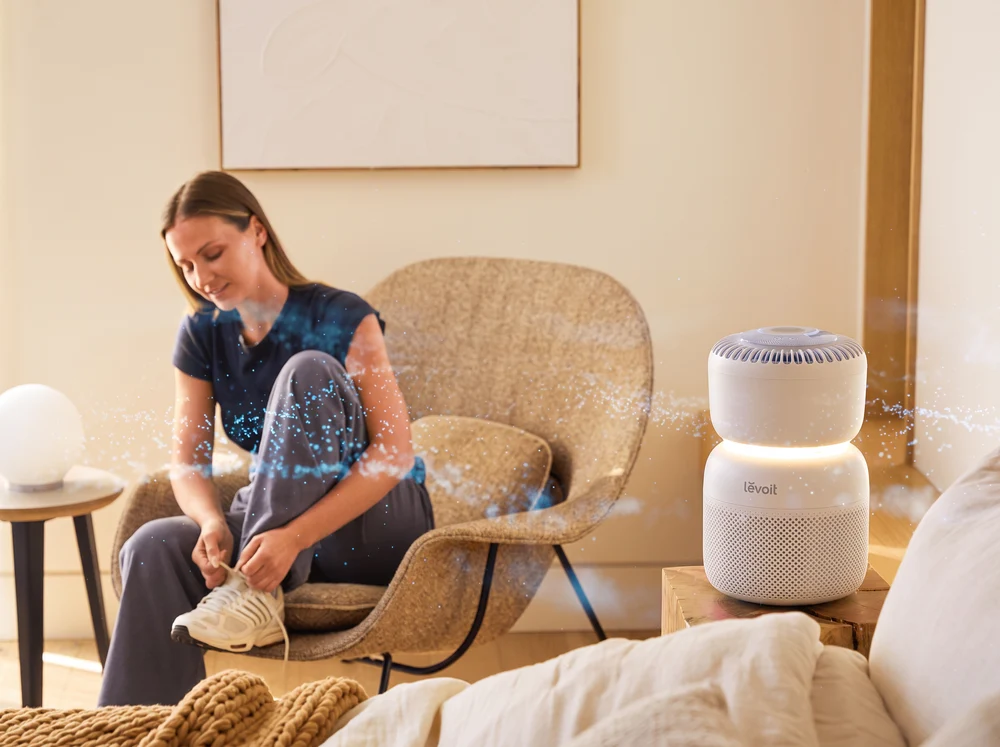
A True HEPA filter is a densely pleated mat of fibreglass or synthetic fibres that traps particles through interception, impaction and diffusion. The counterintuitive part: particles smaller than 0.3 microns are easier to catch than particles at exactly 0.3 microns, because they move erratically and hit fibres by chance.
The 99.97%-at-0.3-microns benchmark isn't marketing. It's a test protocol using DOP smoke or PSL beads at the exact size that's hardest to catch. Everything above — and most things below — gets caught at higher rates.
A pre-filter extends the HEPA layer's life by catching hair, lint and pet fur first. Activated carbon catches the gas-phase pollutants HEPA cannot: VOCs, cooking smells, off-gassing furniture.
Levoit's three-stage design in the Core 300, 400S and 600S runs air through a nylon pre-filter, then H13 True HEPA, then activated carbon. It works well for particles and adequately for odours. If odour is your main problem, look for units with pelleted carbon beds — a Winix 5510 holds roughly ten times more carbon by weight.
Sensors and auto mode: when they're worth it
A laser PM2.5 sensor measures fine particles in real time and feeds auto mode. The fan ramps up during a spike, down when the air clears. In a household that cooks, has pets or opens windows, that's genuinely useful — it removes the need to remember anything.
Not every purifier has one. The Core 300 does not. The Core 300S adds WiFi but skips the sensor. The Core 400S and 600S include laser PM2.5 sensors. If auto mode matters, jump straight to the 400S. If you plan to run a fixed speed and forget about it, save the money.
Sensor accuracy varies. In our testing Levoit's sensor read within roughly 8 to 12 percent of a reference-grade monitor under changing conditions, with a 60-to-90-second response lag. Fine for household use; not laboratory data.
Noise levels: what the dB numbers mean
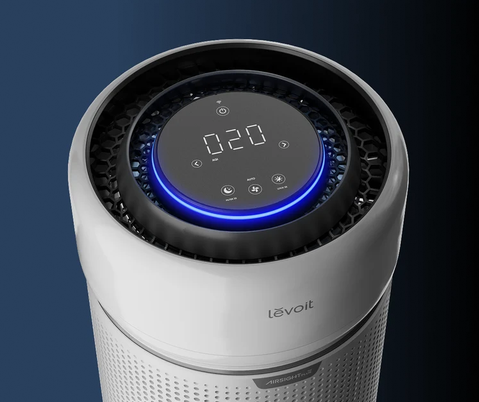
Ratings are measured at three feet from the unit. A rough conversion:
- 24–27 dB — whisper-quiet, effectively inaudible with any background noise. All Levoit Core models hit this in sleep mode.
- 30–40 dB — quiet office. Fine for living rooms, borderline for light sleepers.
- 45–55 dB — normal conversation to loud restaurant. This is max speed. Not for a bedroom.
- 60+ dB — too loud for continuous use.
If a purifier runs mostly on low or auto, the max rating matters less than how loud it is at the speed it actually uses. The Core 400S at speed 1 measures 29 dB; the 600S measures 30. Both are quieter than a dishwasher a room away.
Filter costs: the hidden ongoing expense
| Model | Filter price | Replace every | Annual cost |
|---|---|---|---|
| Core 300 | $30 | 6–8 months | ~$45 |
| Core 400S | $50 | 6 months | ~$100 |
| Core 600S | $80 | 6–8 months | ~$140 |
| Vital 200S | $50 | 9–12 months | ~$60 |
Over three years, filter costs approach or exceed the purchase price of the unit. A cheaper purifier with expensive filters can cost more to own than a pricier one with cheap filters — the Vital 200S is the standout here on running cost.
Smart features: which ones are real
WiFi and app control are useful for scheduling, filter tracking and remote adjustment. Not essential. The VeSync app is decent, occasionally glitchy on initial setup, stable once connected. Alexa and Google Home integrations work reliably.
Scheduling matters if your air quality is predictably worse at certain times. Cooking at 6 every night? Ramp up at 5:45, back down at 8. That extends filter life and keeps the room comfortable.
Filter life indicators are the most useful smart feature nobody talks about. Guessing usually means swapping too early or too late. The app tracks actual runtime and gives you a percentage.
Levoit Core 400S — the default recommendation
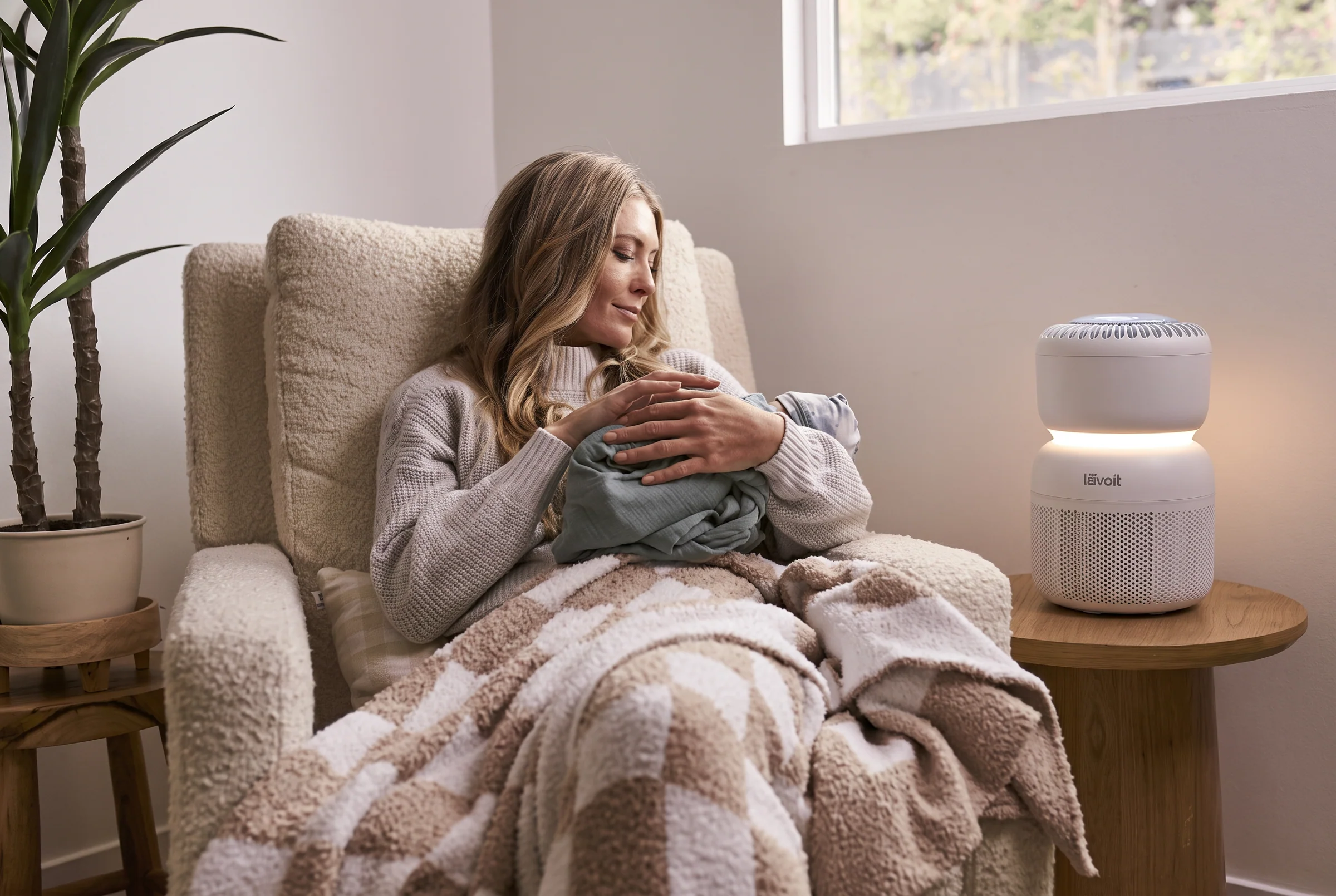
260 CFM, 403 sq ft at 4 ACH, laser PM2.5 sensor and working auto mode. Step down to the Core 300 under 220 sq ft, up to the 600S past 400.
🌬️ Buy replacement filters direct or from a verified retailer — third-party marketplace cartridges rarely meet H13 spec and often fit loosely enough to let unfiltered air bypass the filter entirely. Affiliate link — we may earn a commission at no extra cost to you.
Which model for which room
| Model | Best for | Room size (4 ACH) | Smart features | Price |
|---|---|---|---|---|
| Core 300 | Bedrooms under 220 sq ft | 219 sq ft | No | $99 |
| Core 400S | Living rooms up to 400 sq ft | 403 sq ft | Full VeSync + auto | $189–219 |
| Core 600S | Open-plan 400–635 sq ft | 635 sq ft | Full VeSync + auto | $299 |
★Common mistakes to avoid
- Buying on square-footage claims alone. Always check CADR and the 4 ACH figure.
- Putting it in a corner behind furniture. It needs at least 18 inches of clearance on all sides, positioned near where you spend the most time.
- Never replacing the filter. A clogged filter loses 40 to 60 percent of its CADR before you notice.
- Trying to purify a whole house with one unit. Air doesn't travel between rooms freely enough. One purifier per room that matters, or move a portable as needed.
- Buying an ionizer-only unit. Ionizers don't remove particles — they charge them so they stick to walls. Some produce ozone. Stick with HEPA-first designs.
Frequently asked questions
Do I need a purifier if I have HVAC filtration? Probably yes. Central filters, even high-MERV ones, only clean air when the fan runs. Portable HEPA units run continuously in the room you actually occupy. They complement HVAC rather than replacing it.
Are washable filters worth it? For the pre-filter stage, yes. The main HEPA layer should never be washed — water damages the fibre structure and destroys filtration efficiency.
How do I know when to replace the filter? Smart models show percentage life in the app; manual models use a runtime-based indicator light. Rule of thumb: if the filter looks dark grey or brown, or PM2.5 readings stop dropping as fast as they used to, replace it.
Can air purifiers help with COVID or flu? HEPA filters capture aerosolised particles in the size range that carries viruses and reduce airborne concentration in a room. They don't sterilise air. Public health agencies recommend layered mitigation — filtration plus ventilation plus masking during high-risk events.
One big purifier or two small ones? For a single open room, one large unit is more efficient and quieter than two small ones. For a home with separate rooms and closed doors, several smaller units placed strategically will outperform one big central unit.
Room square footage × 0.75. Check the 4 ACH number, not the 1 ACH one. Insist on True HEPA or H13. Everything else on the box is negotiable.
Want gear like this on your content calendar?
Join AffluencerHub, get AI-matched to brand programs that fit your audience, and track every click to commission in one place.
Apply as a Creator